Jazz Is a Language, but Where’s the Dictionary?
Everyone in jazz education agrees: music is a language.
We tell students to build vocabulary. We talk about fluency. We compare practicing jazz to learning French or Spanish.
But think about how primitive the state of this "language education" actually is.
Every real language has a dictionary. A reference you can open to look up a word, see what it means, where it came from, how it's used in context, and what variations exist.
Jazz doesn't have that.
We tell you to build vocabulary while giving you no reference for what the words actually are or mean.
You learn a lick off a Wes Montgomery record. Is that a "word"? Is it a phrase? Is it three words strung together? Where did Wes get it? Is there a more common variation? How do other players use this same idea?
Nobody can tell you, because nobody's written the reference.
So you end up with students who've memorized 50 licks and have no idea whether they're learning 50 separate words or 50 variations of the same 5 words.
They have no idea what's idiomatic vs what's one player's personal quirk.
This is important because if you don’t know what is or isn’t a word in the language then you don’t know how to pronounce them, how to connect them, and when your sentence is done.
The ‘Grammar’ of Jazz
If you've been following my work, you know about my 9 Essential Jazz Patterns (EJPs). What you might not have noticed is that they map onto parts of speech. (and if not go read my previous blog post, Stop Spelling, Start Speaking: Becoming a Fluent Jazz Improviser, after this.)
EJPs #1-3: Simple melodic patterns are nouns. They are the declarative content that exists either as a scale fragment or triad.
EJPs #4-6: Arpeggio patterns are verbs. They move through the chord tones to define the harmony. They give a sense of motion and range.
EJPs #7-9: Chromaticism and enclosures are adjectives and adverbs. They color and modify specific target notes and ideas, but are meaningless without melodies and arpeggios.
So a bebop phrase parses as a sentence, and here’s a phrase from Charlie Parker that demonstrates this idea.
[Scale-based fragment NOUN] [Arpeggiates the ii VERB] [with an enclosure to target the 3rd ADJECTIVE].
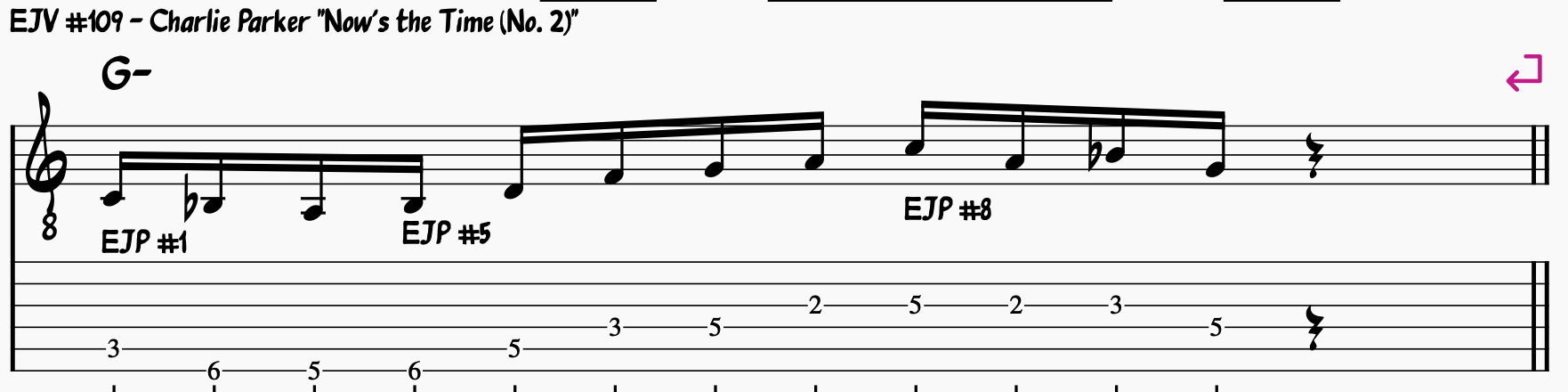
That's a complete, grammatical sentence in jazz. Structurally the same as how English works.
Once you see this, you can't unsee it. And it changes what practicing is about. You stop thinking "I know some licks" and start thinking "I can compose sentences."
What a dictionary of jazz would actually unlock
Imagine opening a reference where you could:
1. Trace any phrase back to its origin. That lick you love from George Benson? Benson got it from Grant Green who got it from Charlie Parker. Everyone talks about the lineage of the language, but until now no one can actually trace that lineage and phrase through recorded history. When you learn a new phrase with this knowledge, you’re becoming part of that musical lineage.
2. Build your personalized vocabulary tutor. Know you're weak on backdoor ii-Vs? Pull every backdoor ii-V phrase across the masters. Want to sound more like Wes? Filter to Wes phrases, and learn the combinations that he actually plays. Working on altered dominants at fast tempos? Filter for that specific chord or sixteenth note phrases. Your weekly practice routine writes itself.
3. Know what word should come next. Phrases travel in pairs. Phrase X is followed by Y 40% of the time. Learning those pairs is what turns reciting licks into speaking fluently and sounding like a native speaker. For example, we don’t say that coffee is ‘powerful’, we say it’s ‘strong’. It’s important to know what combinations of words go together even when two individual words may mean something similar.
4. Compare how different players handle the same harmony. You know that Wes, Pass, and Martino all have different approaches over the same ii-V, but imagine if you could see side by side comparisons of exactly what they do differently.
5. Fingerprint your own playing. Record a solo and find out your vocabulary is 40% Wes, 20% Grant Green, 15% Parker, 25% unique to you. That's your personal combination of influences. It also could work to highlight any EJP or EJV combinations that you are missing in your playing that might be holding you back, such as a lack of chromaticism.
Why this doesn't exist yet
The first reason is there hasn’t been a standard way to objectively classify the musical content of various improvisers before my 9 Essential Jazz Patterns framework.
This framework is what allows us to find the ‘words’ used by improvisers across different tunes, keys, rhythms, etc.
The other reason is that the work is brutal and incredibly tedious. Every phrase has to be transcribed, analyzed, classified by pattern structure, tagged by harmonic and rhythmic context, traced to its earliest known source, cross-referenced with other players who use variants. Multiply that by thousands of phrases across dozens of players.
It's the kind of project that requires someone obsessed enough to spend years on it with no guarantee it'll pay off. Most working jazz musicians don't have the time. Most academics don't have the playing-level pattern recognition. Most data people don't have the ears or understanding of jazz.
I've been doing this quietly for a few years. The database is real and it already works to surface various insights.
Right now it holds 308 phrases across 12 jazz masters — Wes Montgomery, George Benson, Joe Pass, Grant Green, Pat Martino, Charlie Parker, Clifford Brown, Dexter Gordon, Fats Navarro, Louis Armstrong, Oscar Peterson, and John Coltrane.
My goal is to get this jazz dictionary to 10,000 ‘words’ or more, with every major jazz guitarist represented.
The question I'm wrestling with now is whether to turn this into something the rest of the world can actually use or keeping it as something that is for my personal use and understanding.
If you're the kind of player who's been frustrated by "just build vocabulary" as advice without any real reference for what you're supposed to be building, I'd love to hear from you. Send me an email to “chase@chasemaddox.com" with your thoughts or if you’re a member of Chase’s Guitar Academy just comment on the related post or send me a DM.