The Improv Ladder: 5 Levels of Jazz Improvisation No One Teaches
"Just use your ears."
This is the most common advice given to aspiring jazz improvisers, and it's the most misleading.
The problem is that this advice does not take into account what stage of improvisation you are in. In fact, most of the teachers giving advice on improvisation do not understand the 5 levels of improvisation development and how that changes what you should work on.
I’ll give you two examples to make this crystal clear.
In the area of money, we know that the financial advice that’s relevant to someone who barely has $1000 will be vastly different to someone who has $10M. The person with $1000 likely needs to focus on increasing their income by finding a better paying job and doesn’t have to worry about tax optimization. However, for the person with $10M, they would get much more benefit by optimizing their taxes instead of finding a job that pays more.
In the area of health, a beginner is better off starting to build the habit of going to the gym and only as they get more advanced do they level up their thinking to understand how to design their workout program, how to eat correctly for their goals, and the importance of recovery.
The important thing to realize is that there are levels to your development as an improviser, and you must upgrade your concept and abilities to reach the next higher level.
This article will show you what those levels are and the conceptual upgrades you need, but you will still need to put in the work on your instrument to achieve the results.
Playing by ear is not a starting strategy. It's the final result of a process that most people never learn (because no one teaches it).
A strategy that works at Level 5 will fail at Level 1. You can't skip levels. You have to earn each one.
Learning to improvise works the same way, and there are 5 levels you must pass through.
I call this framework the Improv Ladder.
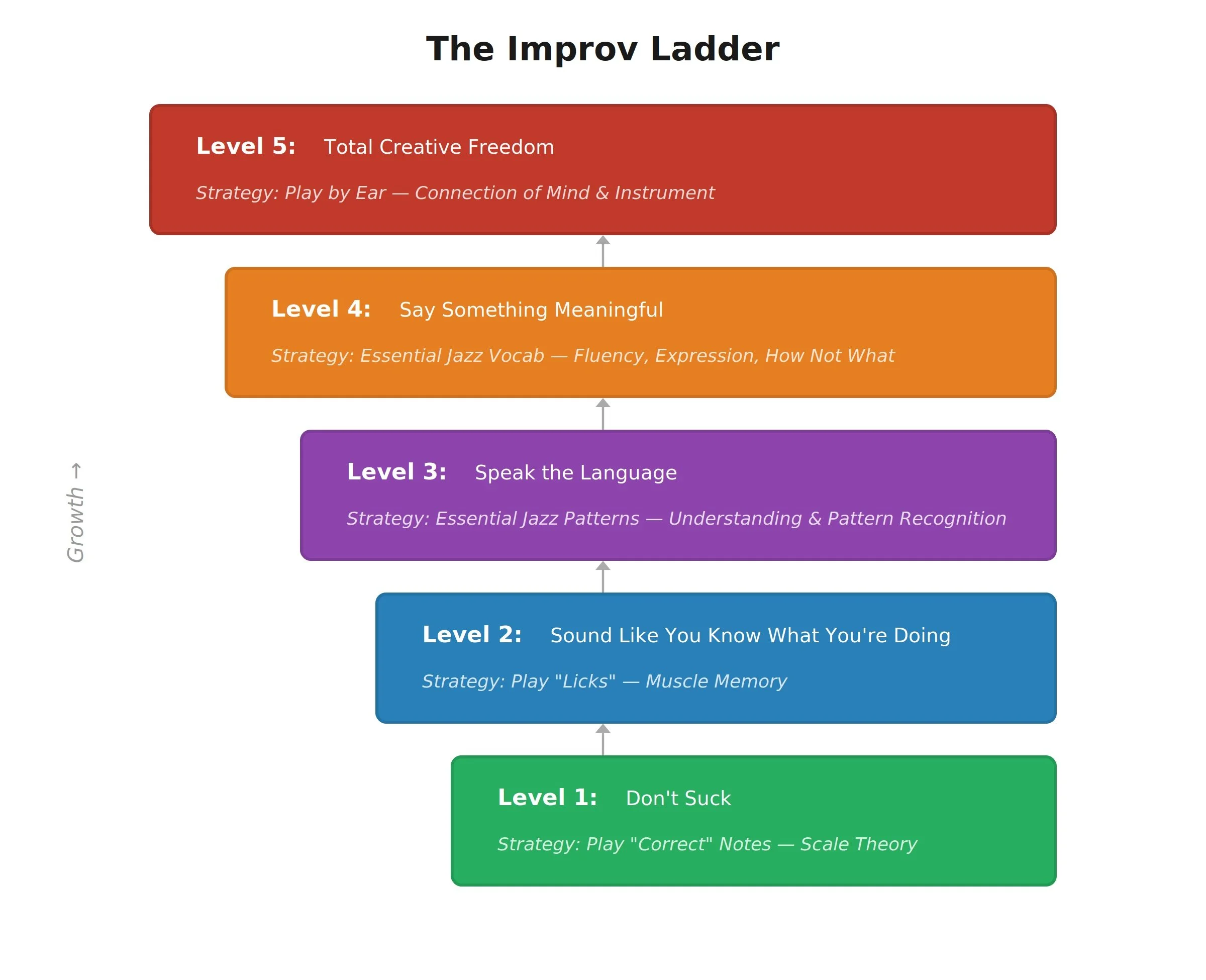
The Improv Ladder
Level 1: Don't Suck
Strategy: Play "correct" notes — Scale Theory
This is where everyone starts. The goal for the improviser at this stage is just “Don’t Suck”.
For most new improvisers, this means trying to only hit ‘correct’ notes when improvising, and being afraid of hitting any ‘wrong’ notes that will cause dissonance with the harmony. (As we’ll see in later levels, we NEED dissonance to play meaningful musical ideas.)
The most common way to hit ‘correct' notes is to play the ‘correct' scale over each chord.
You learn that Dorian works over a minor 7 chord. Mixolydian over a dominant. You memorize your modes, maybe some pentatonic shapes, and you bounce around on the "right" notes.
And it works…sort of. You avoid clashing with the harmony. You survive the tune, if it stays around the same key.
If the song is more challenging with multiple keys or fast chord changes, you are easily overwhelmed by trying to think of each new scale in real time.
Either way, if you're honest with yourself, your improvisation doesn’t really sound like music.
You sound like you’re running scales or exercises over a chord progression. There's no personality, no story, no communication happening.
You're reciting the alphabet and calling it a conversation.
Why it doesn't get you to Level 2:
Scale theory tells you which notes are "safe" but gives you no guidance on how to combine them in a way that sounds like jazz.
You have all 7 notes of the Dorian scale available, but so does everyone else.
The difference between you and someone who sounds good isn't the notes, it’s knowing which combinations of notes form the melodic shapes that define the jazz language.
More scales (or arpeggios) won’t solve this. Learning Dorian in all 12 keys gives you a bigger alphabet, but a bigger alphabet doesn't teach you words.
To level up, you need to be ok with hitting dissonant notes that don’t fit the scale to learn how to control the tension they create.
What to do instead:
Start listening to and learning short melodic phrases from recordings that use the notes you already know.
Don't just learn the scale.
Learn musical ideas that sound like something a jazz musician actually plays. This is the beginning of collecting bigger units of vocabulary instead of collecting notes.
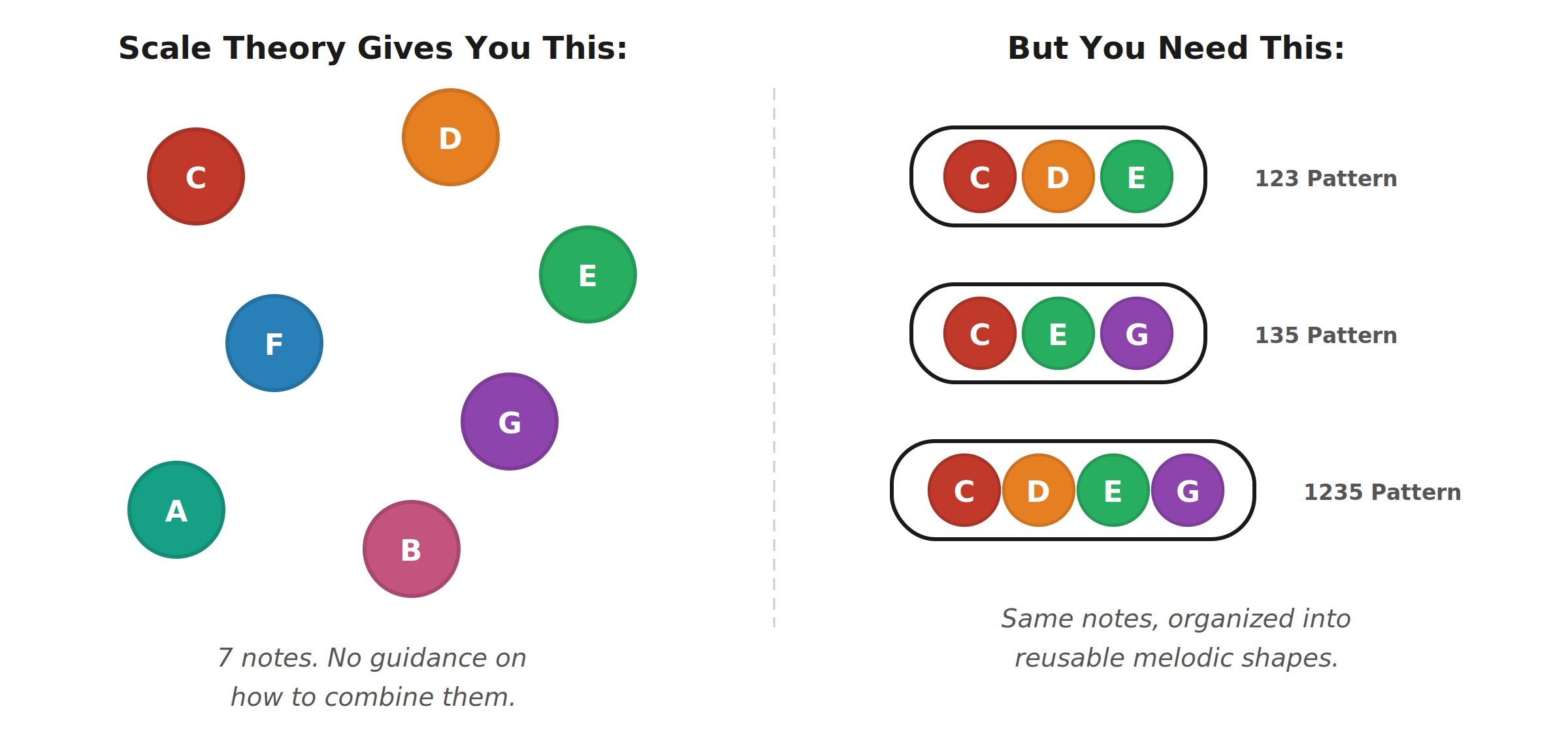
Level 1 Diagram - Scale Theory
Level 2: Sound Like You Know What You're Doing
Strategy: Play "licks" — Muscle Memory
At some point you realize scales alone aren't cutting it, so you start collecting licks.
You transcribe a Pat Martino line here, a Wes Montgomery phrase there. You memorize them and start dropping them into your solos.
This is a real leap forward. You suddenly sound more "jazzy." People at the jam session nod approvingly.
But here's the trap.
Your licks are disconnected. You've memorized a handful of phrases in isolation and you're stitching them together with scale runs in between.
It's like being a tourist who memorized "Where is the bathroom?" and "The weather is nice" in French. You can say those two things convincingly, but you can't actually have a conversation.
Most jazz guitarists get stuck here. Sometimes for years. Sometimes forever.
This is the dreaded No Man’s Land called the Intermediate Plateau.
Why it doesn't get you to Level 3:
The problem with collecting licks is that you're memorizing finished sentences without understanding the words they're made of.
You can play a Charlie Parker ii-V lick, but you don't know why it works. You can't modify it. You can’t lead into or out of it effectively. You can't take a piece of it and connect it to something else. If the chord changes don't line up exactly with your memorized lick, you're stuck.
And so you do what every lick collector does…you go find more licks. But more licks just means a bigger phrasebook. It doesn't bring you any closer to understanding the language.
You could memorize 500 licks and still not be able to improvise a single original phrase.
It’s the same problem as the Level 1 Improviser who collects scales and arpeggios, just using bigger units.
What to do instead:
Instead of learning more licks, start breaking down the licks you already know. What patterns do you see inside them? What are the building blocks? When you look at a Joe Pass line and a John Coltrane line and notice that they're both using a 1235 pattern connecting to a triad, you've stopped collecting phrases and started learning grammar.
This is the shift from licks to what I call Essential Jazz Patterns.
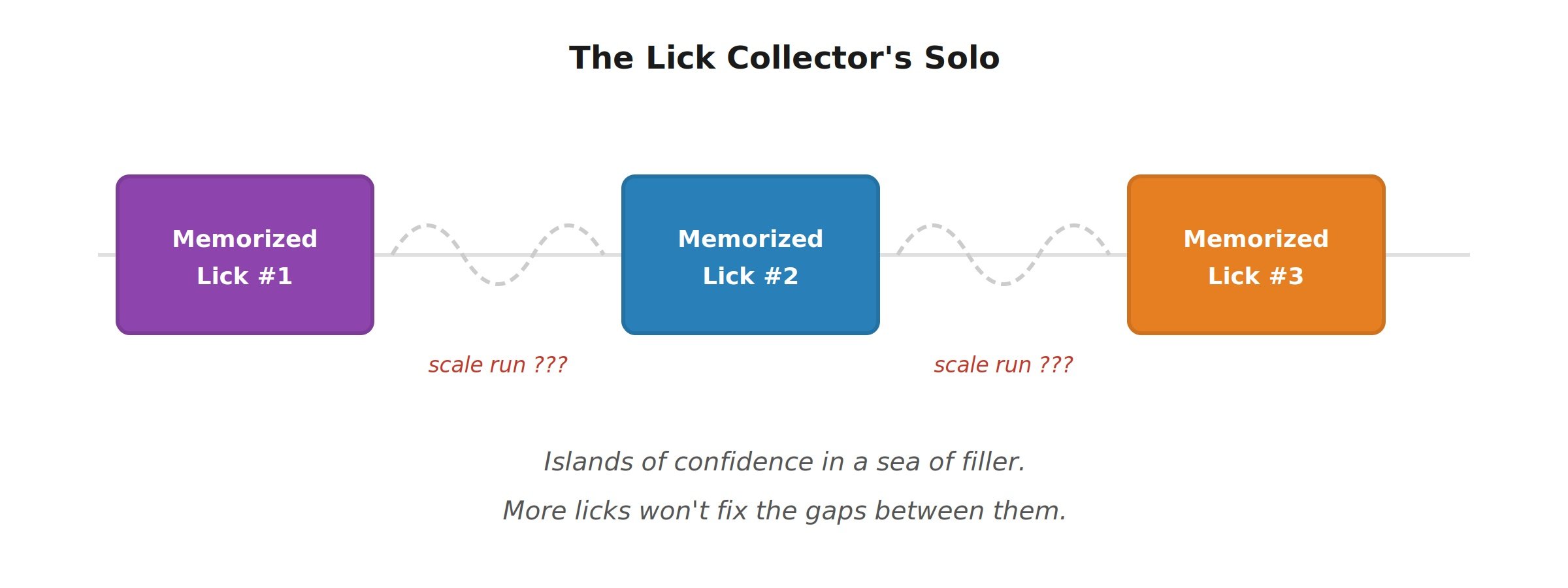
Level 2 Diagram - The Lick Collector’s Solo
Level 3: Speak the Language
Strategy: Essential Jazz Patterns — Understanding and Pattern Recognition
This is the breakthrough level, and it's the one almost nobody talks about.
Instead of memorizing random licks, you start learning the recurring melodic shapes and intervallic structures that the jazz masters use to build lines in real time.
These aren't licks because on their own they’re not enough to form meaningful musical ideas.
They're the building blocks that musical vocabulary is made of.
This is what my Essential Jazz Patterns (EJP) framework is built around.
When you study patterns, you start to understand the grammar of jazz. You see why a Charlie Parker line works. You recognize the same structures in Wes Montgomery, Joe Pass, and George Benson.
You realize that the greats weren't playing random memorized phrases. They were fluent in a system of melodic logic that allows for infinite creativity from a limited set of ideas.
At Level 3, something fundamental shifts.
You stop memorizing and start understanding. You can look at a set of changes and see pathways through them instead of walls.
You can lead into a memorized lick using an Essential Jazz Pattern or continue it creatively after you’ve finished the lick.
If you've read my blog post Stop Spelling, Start Speaking, this is the transition from spelling to speaking.
This is how you go from using the alphabet (scales) to actual words (patterns) that you can combine freely.
Why it doesn't get you to Level 4:
Patterns give you the logic of how jazz lines are constructed. But knowing the grammar of a language doesn't make you eloquent.
You can build grammatically correct sentences all day long. Subject, verb, object. The structure is right. But the result is stiff, mechanical, and lifeless.
If the goal is fluency in the language of jazz, this stage is still like slowly building the phrases in your head while trying to have a conversation.
At Level 3, you can construct lines that outline the harmony and connect logically from chord to chord. But they often lack feel, nuance, and the idiomatic phrasing that makes a line sound like real jazz instead of a well-constructed exercise.
Grammar tells you what's possible. It doesn't tell you what's expressive or musical.
What to do instead:
Start studying how the masters used these patterns in real musical contexts and combined them to form Essential Jazz Vocab. You even need to go beyond patterns and vocab to study how the masters phrased them. What was the rhythmic placement, articulation, dynamics, space, and harmonic context that they used?
Learn specific vocabulary in context. A ii-V-I line isn't just a 1235 pattern connected to an enclosure. It's a musical statement with a shape, a feel, and an intention behind it.
This is the shift from patterns to vocabulary.
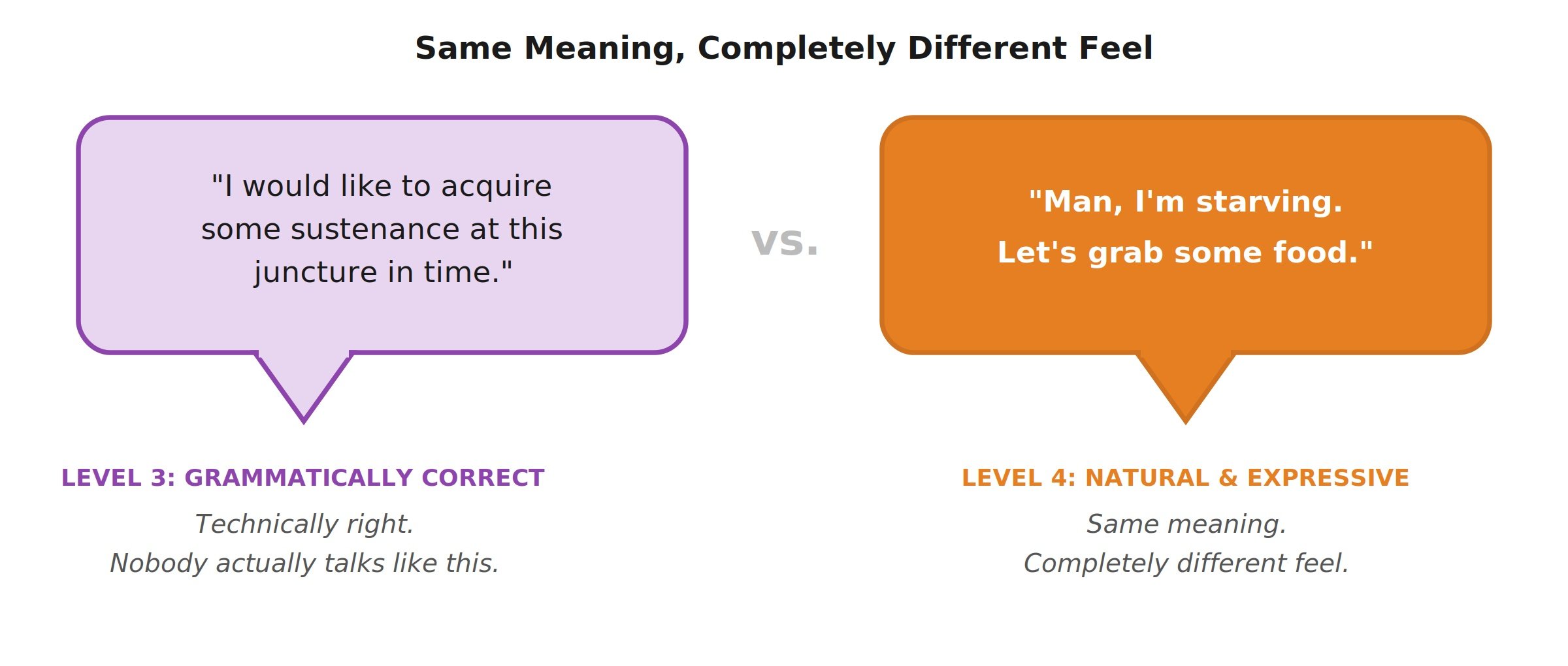
Level 3 Diagram - Same Meaning, Completely Different Feel
Level 4: Say Something Meaningful
Strategy: Essential Jazz Vocab — Fluency, Expression, How Not What
Level 4 is where you go from correct to compelling.
This is the Essential Jazz Vocab (EJV) stage.
Now you're studying how the masters used those patterns in real musical contexts with specific ii-V lines, blues language, turnaround vocabulary, the way Wes played vs Joe Pass vs George Benson vs Grant Green.
You're learning idioms, style, and feel.
The shift at Level 4 is from what to play to how to play it.
Rhythmic phrasing. Articulation. Dynamics. Storytelling. The rise and fall of tension and resolution across a phrase.
You start making musical choices not because the theory says you can, but because you hear what you want to say and have the vocabulary to say it.
This is fluency.
You're not translating from Music Theory to Jazz in your head anymore. You're thinking in the language.
Why it doesn't get you to Level 5:
At Level 4, you're fluent but you're still choosing and thinking.
You hear the chord coming, you search your vocabulary for something that fits, and you make a decision. There's still a moment of conscious selection happening between your ear and your hands.
It's like speaking a second language fluently, but not quite natively.
You can express anything you want, but there's still a thin layer of translation happening. You're thinking about the language while you use it.
This conscious selection means you're always a fraction behind the music. You're reacting to the harmony rather than flowing with it. And because you're choosing, you tend to reach for what's comfortable and familiar rather than what the music is calling for in the moment.
You don’t find yourself in moments where you played something pleasantly unexpected because the music led you there.
You can't practice your way past this with more vocabulary. No amount of additional learning alone eliminates the gap between thinking and playing.
What to do instead:
Play. A lot. You need to put yourself in real musical situations. Whether that’s jam sessions, gigs, or the newly possible option of playing in real-time with people online via software like FarPlay.
The goal is not to learn new material but to internalize what you already know so deeply that it stops being vocabulary you choose and becomes a part of how you hear and respond to music.
You have to trust the process here. The conscious mind has to get out of the way, and that only happens through sustained immersion.
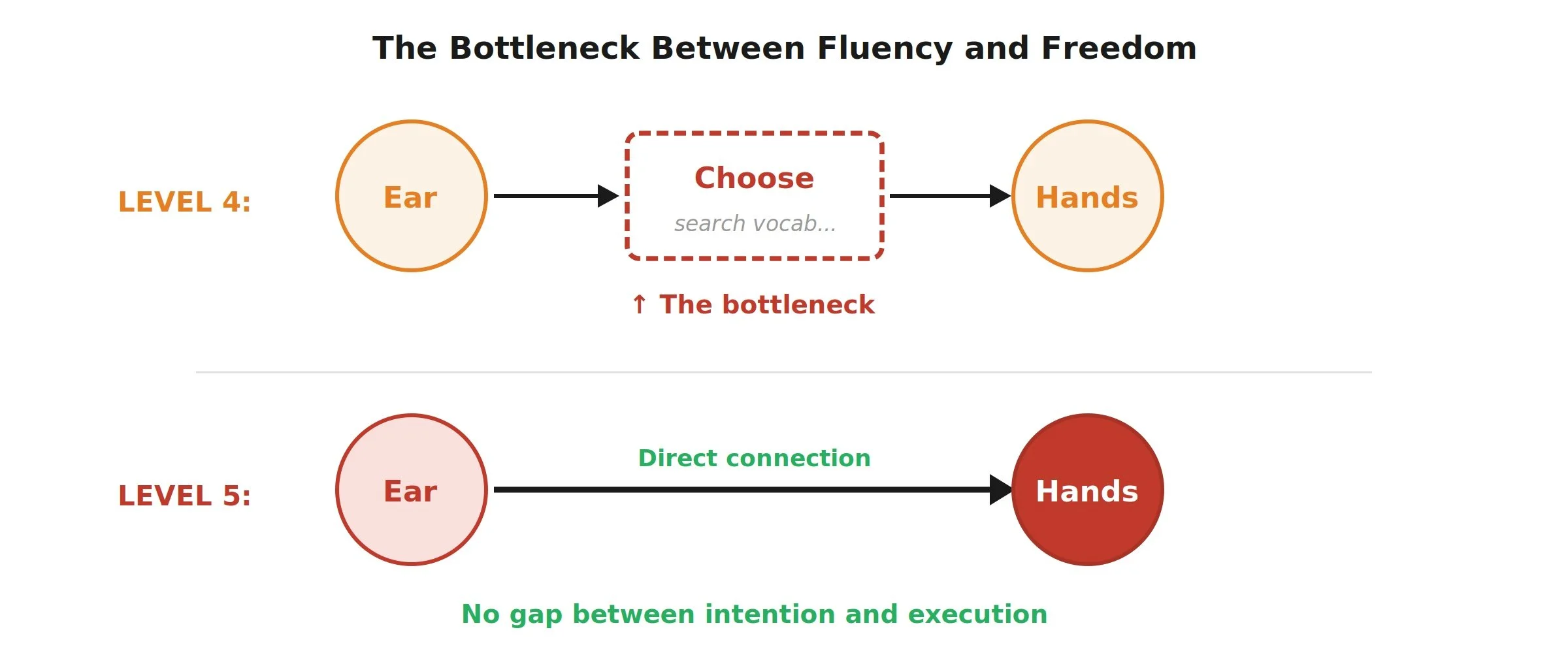
Level 4 Diagram - Fluency and Freedom
Level 5: Total Creative Freedom
Strategy: Play by Ear — Connection of Mind and Instrument
And now, finally, ”play by ear" actually works.
At Level 5, your vocabulary is so deeply internalized that it becomes invisible. The patterns, the vocab, and the theory is all still there, but it's operating beneath conscious thought.
Your ear hears a phrase, and your hands play it. There's no gap between intention and execution.
You hear a musical idea in your head and can ‘see’ it laid out on your instrument.
This is what people mean when they talk about "being in the zone" or "playing from the heart."
It looks like magic from the outside.
But from the inside, you know it's not magic. It's the accumulated result of every level that came before.
Getting to this level as someone who was not a natural musician took me over a decade of study, and would’ve been accelerated if I had a teacher systematically show me the concept of Essential Jazz Patterns and Essential Jazz Vocab.
The paradox is that playing by ear is simultaneously the most natural thing in the world and the last skill you develop.
A toddler can sing by ear. But a jazz musician playing by ear over Donna Lee at 240 BPM is doing something entirely different.
They’re drawing on thousands of hours of internalized language that flows without conscious effort.
Level 5 isn't a destination you arrive at permanently. It's a state you access more and more frequently as your foundation and musical vocabulary deepens.
Even the greatest improvisers have moments where they're thinking, searching, choosing. The difference is that their Level 4 is so strong that even their "conscious" playing sounds effortless to everyone else.
Staying at this Level is not an achievement that’s won forever. It requires constant reinforcement of simple Essential Jazz Patterns, absorbing new Essential Jazz Vocabulary, listening to records for new ideas and new methods.
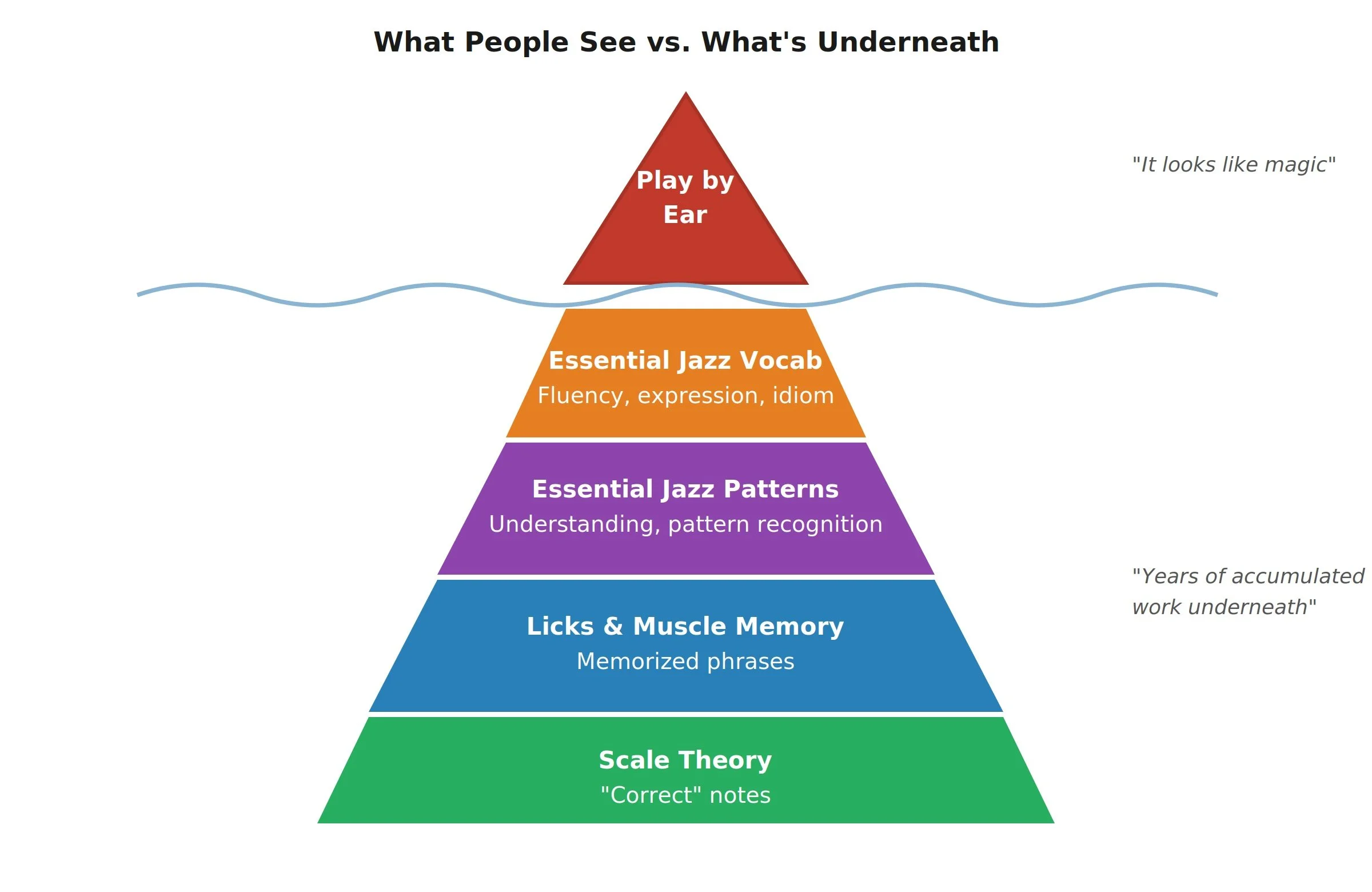
Level 5 Diagram - What People See vs. What’s Underneath
Why You Can't Skip Levels
Here's what frustrates me about so much jazz education.
People are given Level 1 tools and Level 5 goals with nothing in between.
Learn your scales. Learn your arpeggios. Now go be creative. Express yourself. Use your ears.
It's like telling someone to build wealth by "just investing" without teaching them how to increase their income, budget, save, build a company or side business, or understand compound interest first.
The students who get stuck aren't lacking talent.
They're lacking Levels 3 and 4.
They need the bridge from "I know the theory" to "I can actually play." That bridge is Essential Jazz Patterns and Essential Jazz Vocabulary.
It’s not random licks, but systematic vocabulary acquired through pattern recognition and contextual fluency.
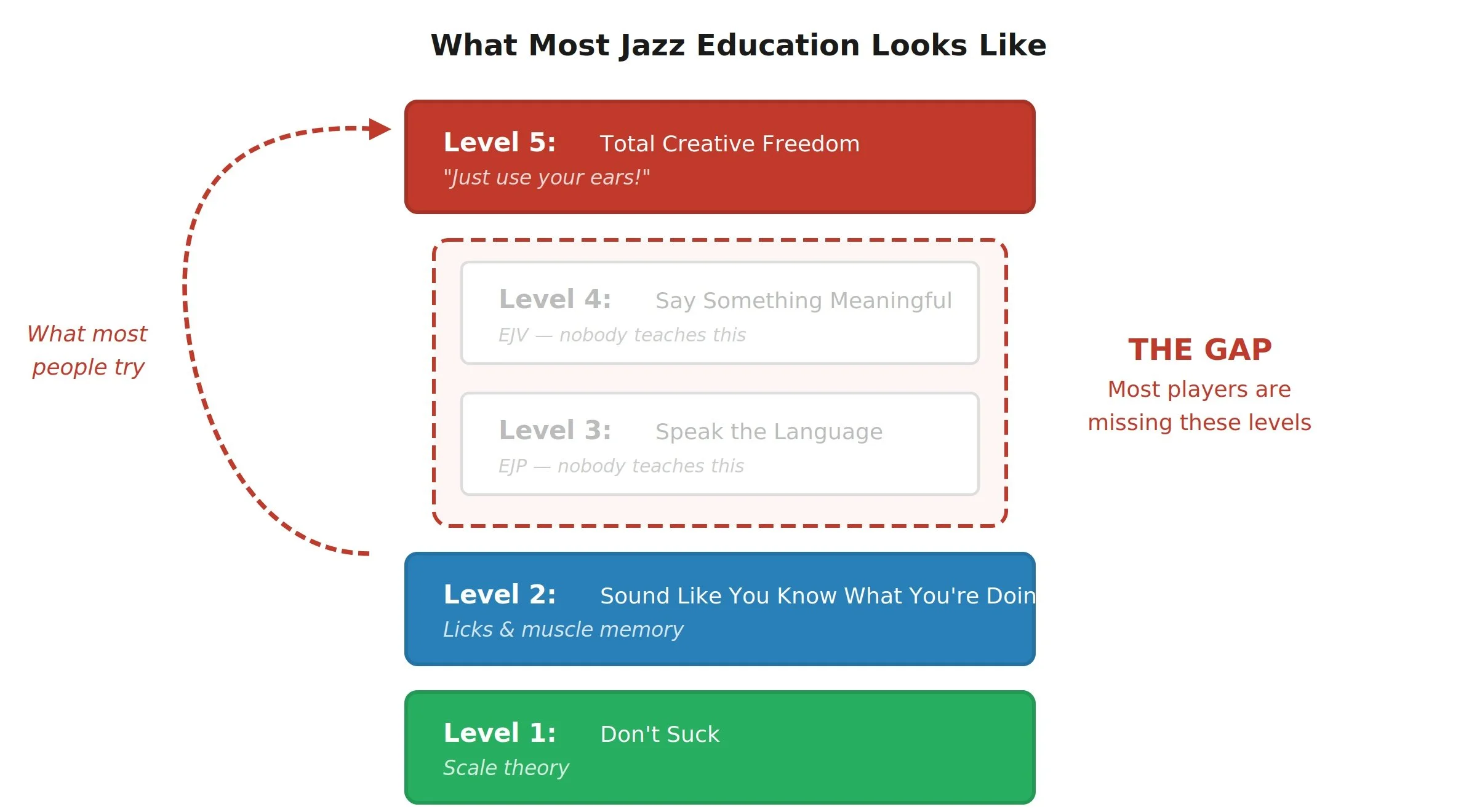
What Most Jazz Education Looks Like
Jazz is a language. You learn it the way you learn any language.
Not by studying grammar textbooks forever.
Not by being dropped in a foreign country with no preparation.
But by systematically building vocabulary in context until the language becomes part of you.
Identify which level of the Improv Ladder you are on. Work the necessary steps to move to the next level, and trust the process.
The creative freedom at the top is worth the effort.
If you want my personal help moving up the levels of the Improv Ladder, I’d encourage you to check out my Master Improvisation Blueprint curriculum inside Chase’s Guitar Academy which takes you step-by-step through the three phases of learning Essential Jazz Patterns and Essential Jazz Vocab.
You can check out the full 7-day free trial and get a personalized level assessment. No charge today. Cancel anytime. Learn more here.