Stop Spelling, Start Speaking: Becoming a Fluent Jazz Improviser
“I know my scales…why can’t I improvise?”
I’ve taught hundreds of adult students inside Chase’s Guitar Academy, and learning to improvise is by far the biggest challenge they face and want to overcome.
So why do people struggle to improvise?
In my experience, the problem comes from viewing improvisation as a problem in the first place, where there are ‘correct’ or ‘wrong’ notes for any given chord.
Instead of this academic model, students need to adopt a language model where improvisation is another form of communication.
Music as a language is not a metaphor.
At its core, music is a language. The purpose of music is to communicate, although unlike spoken languages, music doesn’t communicate on the level of concepts but rather on the level of perception and emotion.
In order to understand how to spontaneously create melodic ideas — improvisation — we must first understand the nature of what we are trying to create.
The Language Parallel
When we learned our first language, we started by repeating sounds we heard, then recognizing that some sounds were combinations of two or more sounds, like “Da-Da” or “Ma-Ma”. We go on to learn many of these simple combinations that give us reactions in the real world. Then we might start to combine these words to form imperfect, but understandable phrases like “Up Dada” or “Eat Mama”.
The point here is that we do NOT start learning a language by taking a look at the alphabet, learning grammar, and then moving letters around to fit a correct order.
And yet, this is how 99% of new improvisers are taught to improvise.
Step 1) Learn your scales. This is our musical alphabet.
Step 2) Play the ‘correct’ scale over each chord. These are our musical grammar rules.
Step 3) ???
Step 4) Great Improvisation!
Anyone who has tried to learn to improvise has run into this mysterious gap going from “I know my scales” to “I can improvise”, and no amount of music theory knowledge can cross that gap.
So what do we do to improvise? The same thing that worked when you were a baby…learning sounds, words and then combining them into phrases.
Here’s the parallel:
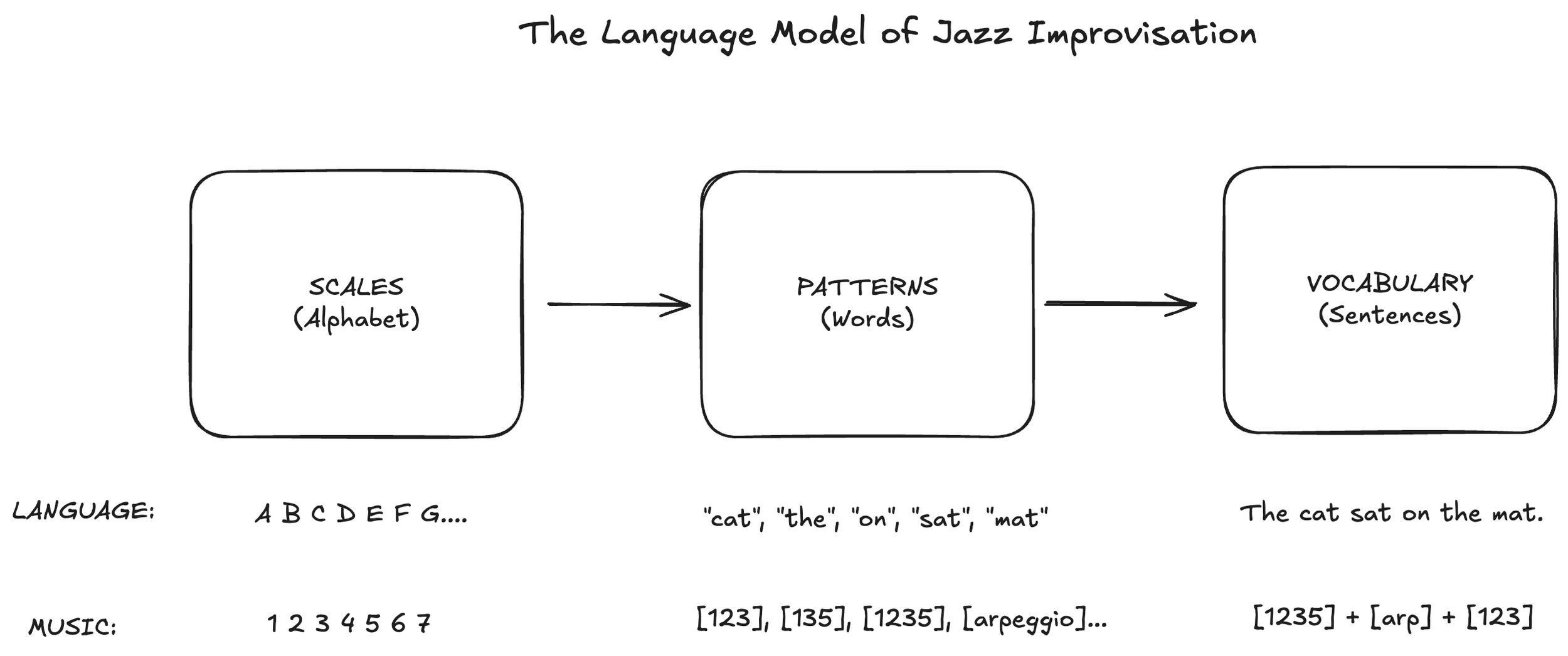
The Language Model of Jazz Improvisation
Scales give you the notes to use, but don’t tell us how to combine them to form meaningful words.
Essential Jazz Patterns are the word equivalents that we combine to form sentences.
Essential Jazz Vocabulary are ordered combinations of words that form complete musical phrases.
Patterns vs. Vocabulary
Essential Jazz Patterns are the ‘words’ of our musical language that when combined together form ‘sentences’ that I call Essential Jazz Vocab. These isolated patterns are combinations that form in three distinct phases, with many variations beyond what I consider the nine Essential Jazz Patterns.
The Essential Jazz Patterns in Phase 1 are fundamental melodic combinations that exist in any genre. The two most common ways that a melody will move are stepwise (by half or whole step) covered in the 123 Pattern, or by skip (as in the 135 Pattern or triad).
In the Key of C, EJP #1 would be any combination of the set of notes {CDE}, or {GAB}, or any 3 notes in the key that are stepwise.
For EJP #2, this would be any combination of three notes that are the result of two skips such as {CEG}, {GBD}, etc.
EJP #3 is a common combination of EJP #1 and EJP #2 where we have both the stepwise motion of a {123} and the triad pattern of a {135} together in a four-note group, such as {CDEG}, or {GABD}.
These are unordered sets of notes, which means they can be used for improvisation in any order, with repeated notes, backwards or forwards. The important part is that together they form a musical concept loaded into your mind that you manipulate to create a melody with.
Phase 1: Simple Melodic Ideas
EJP #1 - 123 Pattern (stepwise)
EJP #2 - 135 Pattern (skip)
EJP #3 - 1235 Pattern (combination of stepwise and skip)
Phase 2 of the Essential Jazz Patterns framework consists of arpeggio-based ideas. Jazz harmony tends to go beyond simple triads to use 7th chords and extensions upon those.
In order for the improviser to accurately define this harmony in their playing, it’s become common language to play through four-note arpeggio groups in three specific ways.
EJP #4, the first pattern here, is playing from the root up to the 7th, such as [CEGB].
EJP #5 is playing from the 3rd of the chord up to the 9th, as in [EGBD].
And, EJP #6 is a specific movement called a pivot arpeggio where the second note of the arpeggio is adjusted by an octave, such as [CEGB], where the ‘E’ note is down a sixth from the C and then continues ascending to ‘G’ and ‘B’. This has a real musical function to allow the improviser to address the harmony but stay within a more limited range of their instrument.
Phase 2: Arpeggio-Based Ideas
EJP #4 - 7th Arpeggio (root to 7th)
EJP #5 - 9th Arpeggio (3rd to 9th)
EJP #6 - Pivot Arpeggio (arpeggio with octave displacement)
Finally, in Phase 3, we discuss three of the most common chromatic devices used to connect between simple melodic ideas and arpeggios. You can think of chromaticism as the connective tissue that holds the meat of your musical ideas together.
EJP #7 is the idea of using continuous chromaticism ascending or descending to link the chord tones of the harmony.
EJP #8 introduces the idea of using chromaticism above and below a note you want to target.
EJP #9 shows how to extend this idea of targeting a given note with more chromaticism.
Phase 3: Chromatic Connectors
EJP #7 - Continuous Chromaticism
EJP #8 - 2-Note Enclosure
EJP #9 - 3-Note Enclosure
I have done research on thousands of jazz transcriptions and found that combinations for ALL nine of the Essential Jazz Patterns exist in real solos from recognized jazz masters. In other words, you can combine any EJP with any other EJP pattern and find that it exists in real jazz solos effectively.
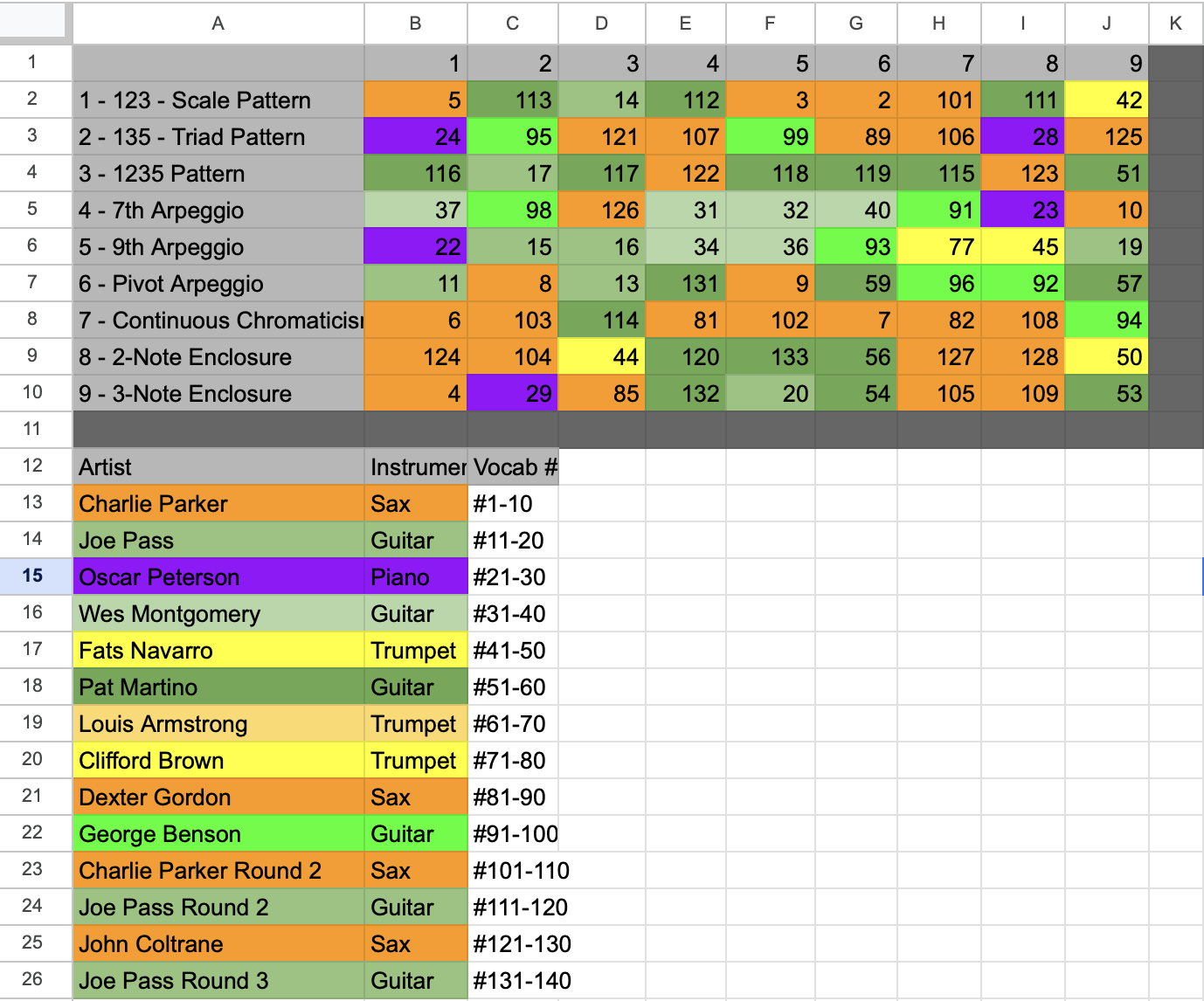
9×9 Combination of Essential Jazz Patterns
For example, combining EJP #3 with itself forms the basis of much of John Coltrane’s improvisation over his famous “Giant Steps” solo. I call this Essential Jazz Vocab 3.3 (EJP #3 connected to EJP #3).
Combinations of Phase 1 of EJP with Phase 3 forms much of the jazz language we hear from horn players in the bebop era such as Charlie Parker or Clifford Brown.
If we want to gain fluency in the jazz language to the level of these masters then just like we did in learning our native language, we need to focus our time on learning and speaking new sounds (EJP) and put them into practice by combining them together (EJV).
If you are interested in how exactly to learn and practice the Essential Jazz Patterns and Essential Jazz Vocab, I have an entire curriculum structured around this inside Chase’s Guitar Academy, but for now let’s dive deeper in understanding the three elements of music and what that teaches us about improvising.
The Three Elements: Melody, Harmony, Rhythm
Every note has a melody, harmony, and rhythm at once. If I play a ‘C’ note, it has a distinct pitch, a harmonic context implied or related to other notes I played before or after, and a specific time element such as the duration it’s held or articulation of the note.
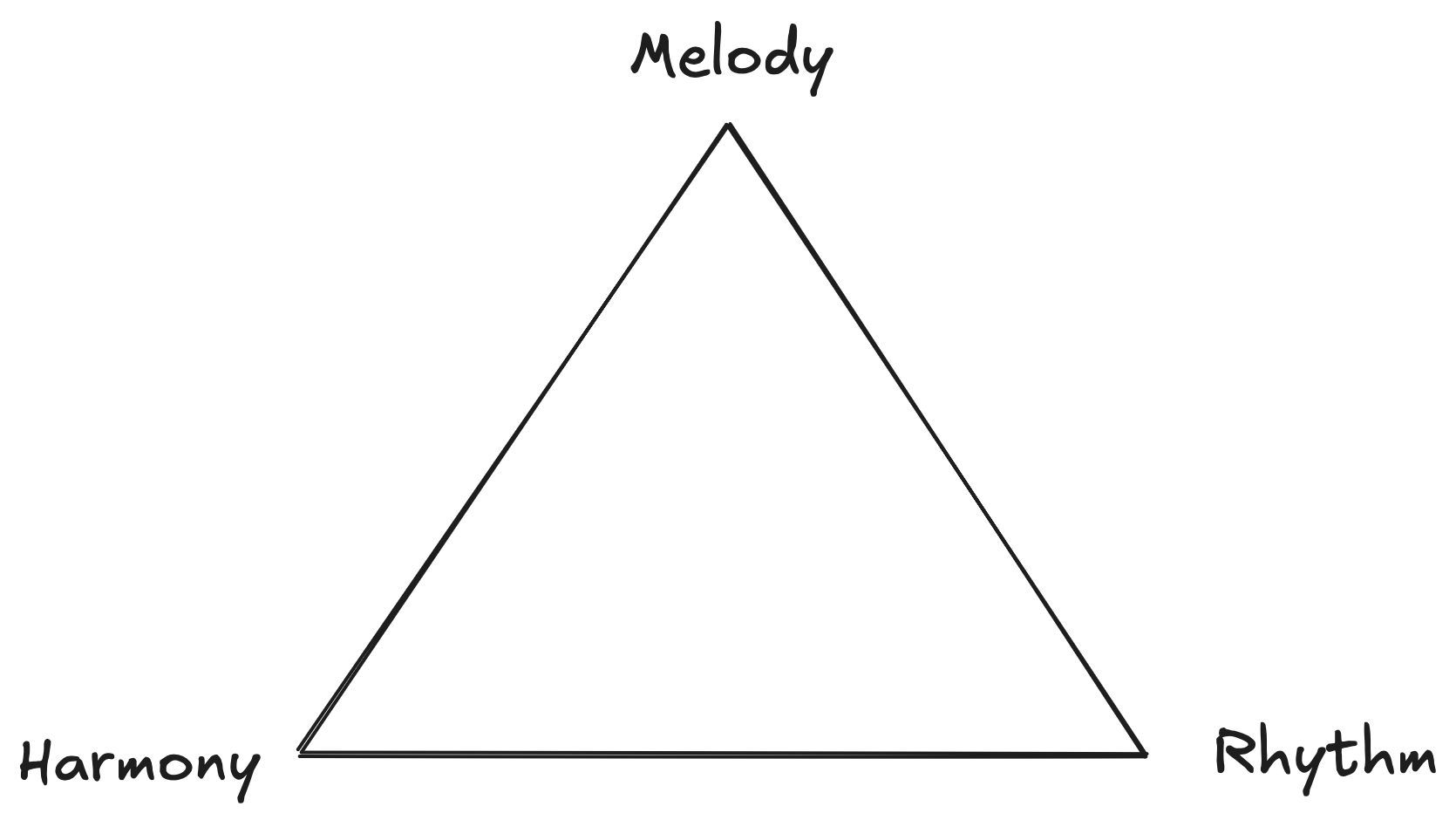
Melody, Harmony, and Rhythm Triangle
These same elements exist in language as well.
Each word has a specific sound, a context that changes depending on the other surrounding words, and varying phrasing elements related to how the words are spoken.
While we cannot actually separate the three elements apart, we can learn a lot about how music functions by thinking of the relationship between any two of these three elements.
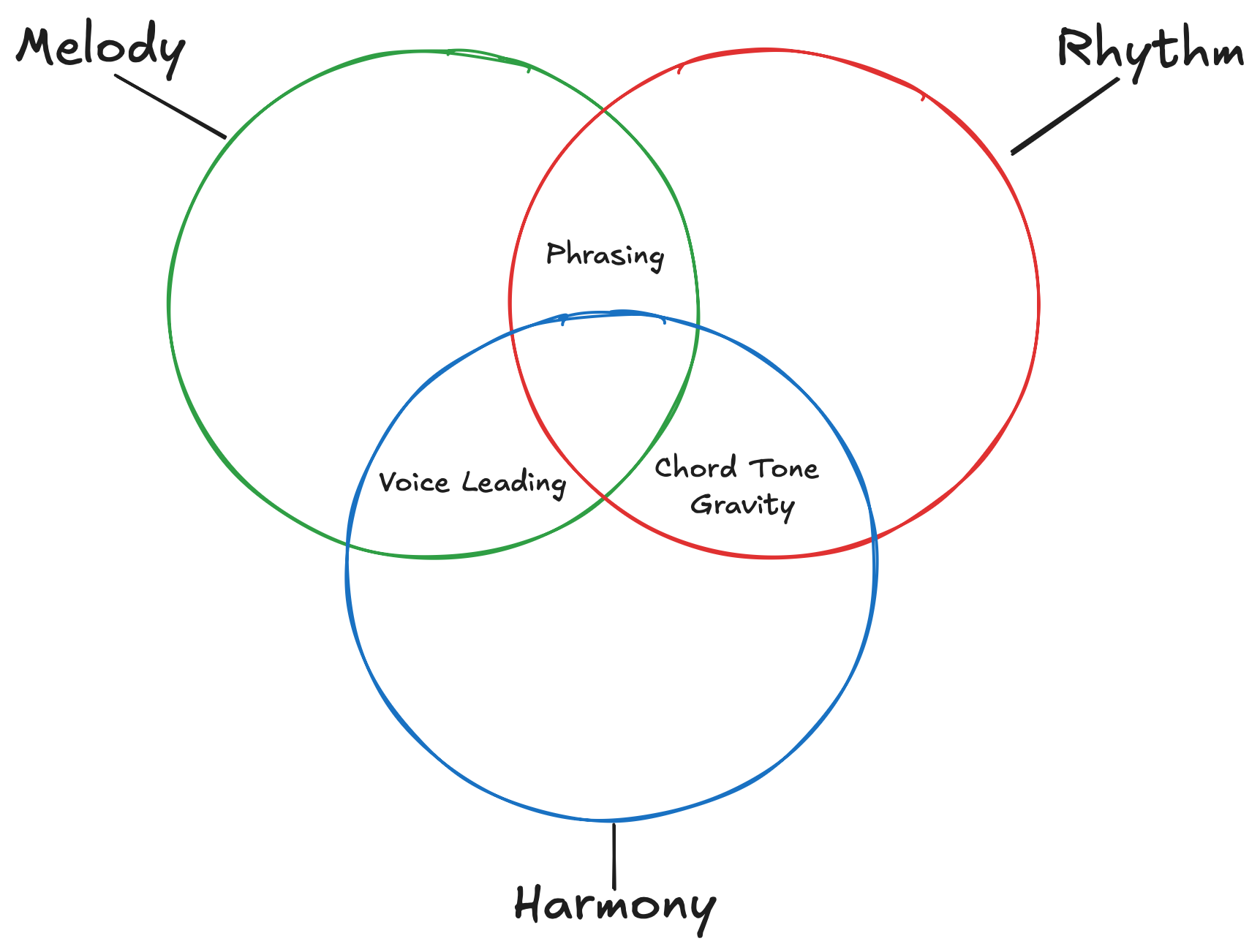
Melody, Harmony, and Rhythm Relationships
Let’s start with the connection between melody and harmony, which is voice leading.
Voice Leading (Melody ↔ Harmony)
One of the ways that harmony functions, at least in traditional Western harmony, is to move in a path of least resistance.
Think of the chord G, made up of the notes G B D, leading into the chord C, made up of the notes, C E G.
If we think of each of the notes of the G chord as distinct melodic voices, just like in a choir, they want to go to one of the notes of the C chord with the least movement necessary.
What results is that the ‘G’ note doesn’t need to move at all and stays singing ‘G’.
The ‘B’ note has a strong pull up by half step to the ‘C’ of the C chord because that’s much closer than the other note ‘E’.
And, the ‘D’ note goes up by whole step to the ‘E’ of the C chord.
This principle of music is fundamental to how melodies move in their harmonic context, and is one that the improviser must master to creatively move their melody through a given set of chords.
A beginning improviser will jump their melodic idea seemingly at random from one chord to the next without constructing a clear voice leading path for the listener to follow.
A master improviser will know the standard voice leading paths and create melodies that weave through them, or even imply other voice leading paths not spelled out in the original harmonic context.
Phrasing (Melody ↔ Rhythm)
When we think of the great orators of our time, we rarely think first of the vocabulary they used.
Instead what comes to mind is the manner in which they spoke— the rise and fall of their voice, the articulation of their words, and the pauses and breath that let their words sink in.
As an improviser, we also have access to these same elements of phrasing the vocabulary we use and in many ways they can be more powerful than the notes we choose to play.
The connection between melody and rhythm is phrasing, or any element of time that affects the notes you play.
This can include articulation, dynamics, accents, note length, breath, and space between phrases.
As novice improvisers, we often struggle with leaving space, creating dynamics within a phrase, and intentionally emphasizing certain notes.
A confident improviser has knowledge and experience that the phrase they played is worth listening to, and thus needs space for the listener to digest the musical idea.
A confident improviser takes charge of the emotional state they want to project for the listener, and thus creates dynamics with their notes to become powerful or quiet as fits the musical statement.
And, a confident improviser knows when to repeat a note for emphasis, when to play with the rhythmic element in what’s being stated to invite the listener in to respond.
There is no secret to good phrasing because it connects directly to how you personally hear the music in your mind.
You develop good phrasing by listening to great improvisers for more than the notes they play, trying and failing to match them, and over time developing your musical voice.
Chord Tone Gravity (Harmony ↔ Rhythm)
Let’s focus now on the relationship between harmony and rhythm, or what I like to call “Chord Tone Gravity”.
The question we’re asking ourselves here is “How is the harmonic content of our improvisation affected by where it is placed rhythmically?”
In order to understand this, we must first understand that not all beats are created equal.
Depending on the meter and genre of the music, some beats are felt as strong beats and some are felt as weak beats.
Take the example of a waltz which is counted in 3/4 time signature or three beats per measure.
Try to hear a waltz in your head, like the classic “Blue Danube”.
What you’ll hear is an emphasis on the first beat (the 1 if you’re counting 123), followed by a lighter beat 2 and beat 3.
That first beat is considered the strong beat and beats 2 and 3 are weak beats.
One other concept that is critical to understand here is downbeats and upbeats.
Hear a favorite medium-tempo song in your head and tap along with your foot.
You should have your foot ‘down’ when counting beats 1234, and your foot would be ‘up’ in between those downbeats.
Notes that fall on downbeats are heard by our brain as emphasized, important notes for the harmonic context, while notes that fall on upbeats are felt as less important, passing notes.
This principle is so critical as an improviser because it means that not only do we need to choose a note that fits the harmonic context, and is being voice led well from previous notes, but we also need to place the notes in the rhythmic context that matches.
In other words, we want the chord tones of the harmony to fall on downbeats and other passing or chromatic notes to fall on upbeats.
But, you might be thinking, some great improvisation has chord tones on upbeats and chromatic notes on downbeats? Doesn’t that break this principle?
Yes it does break this principle, but in doing so the master improviser creates a harmonic and rhythmic tension that they can use to create a stronger resolution in the listener’s ear.
So, let’s talk about creating tension and resolution as an improviser.
Tension and Resolution
A musical pitch can either stay in place, move up, or move down. These movements, or lack thereof, are what allow music to create a sense of stability or rising and falling. On a deeper level, we can manipulate that fundamental nature of musical pitch to form strong feelings of tension and release over a period of time and evoke various emotions as a result.
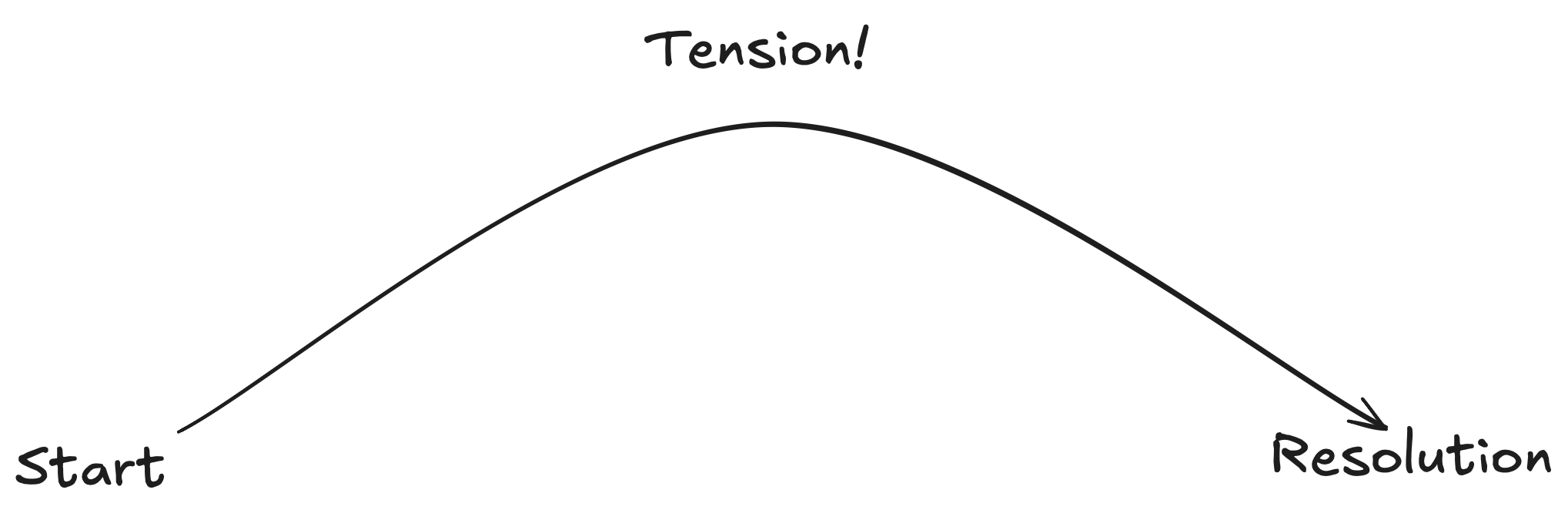
Tension and Resolution Arc
On the melodic side, notes have a certain relationship with the harmony as either being consonant or dissonant, and with varying degrees. For example, play a ‘C’ on a CMaj.7 chord has a clear consonance, and that same ‘C’ note played on a DbMaj.7 chord (the major 7th of the chord) would have a clear tension to want to move up to a ‘Db’.
As improvisers, it’s up to us to be aware of how each note creates or releases tension depending on the harmony.
On the harmonic side, we can play notes that don’t fit the given harmonic structure and create tension. This is essentially what happens when we use chromaticism to embellish our melodic ideas. We are creating small moments where the note we’re playing doesn’t fit the chord and then quickly resolving that note to one that does fit the chord. One of the most effective ways to do this is by starting on a chord tone, playing chromatically, and then ending the phrase on a chord tone. When done well, the listener’s ear will experience this as a musical moment depending on their taste for the dissonance used.
And on the rhythmic side we can also create tension in the form of a rhythmic expectation. On the phrase level this can be done with rhythms that are repeated multiple times and then changed, in the same way a comedian might set up an expectation and then twist it to deliver the punch line.
Within the phrase we can also create tension rhythmically by having phrases start ahead of the harmony in anticipation, or emphasizing upbeats to give a sense of forward movement and instability. This rhythmic tension is resolved when we land our musical phrase and leave space.
For the beginner improviser who doesn’t know when to stop their phrase and doesn’t leave space, this creates a constant feeling of instability for the listener.
When in the act of improvisation, you want to ride the wave of tension and resolution, and develop your own style and taste for the kinds of tension and resolution you want to create.
As you progress as an improviser you go beyond thinking note to note, and then phrase to phrase, and eventually chorus to chorus, using an entire solo to tell a story with a beginning, middle, and climactic end.

Multiple Arcs of Tension and Resolution
There is a concept I learned from my brief study of jujutsu called Shoshin or beginner’s mind.
It’s the mindset to always approach learning from the perspective of a beginner, with openness and without preconceived ideas.
For many new improvisers, they’ve absorbed many preconceived ideas about what improvisation is and how it should be learned.
In the flood of information online about improvising, it’s natural to feel like you’re drowning in a sea of theory, scales, licks, and rules.
And ironically, trying to do too much and tackle everything at once is really a defense mechanism to not address your weaknesses directly.
Can you make a melody with a 123 pattern? Can you make a single note swing?
If not, why would you be able to play a great solo?
Have the courage to start small and with an open mind.
Learn the foundations of improvising. Learn the sounds and the words. Learn how to combine them into meaningful phrases.
The path to improvisation is simple, but not easy.
The reward is communication, growth, and in many ways, a feeling of transcendence that elevates our sense of self.
Want to become a more confident jazz guitarist? Learn how to play jazz guitar confidently and make consistent progress by following our proven, structured curriculum inside Chase’s Guitar Academy. Try a 7-day free trial, cancel anytime, no charge today.